The challenge
How do you strengthen stakeholder communication skills for experienced professionals who regularly deal with complex, high-stakes situations?
Skills Café partnered with Tata Steel to design an experiential stakeholder communication program built around a simple principle: communication skills improve through practice, not just instruction. Instead of relying primarily on presentations and frameworks, the program used case studies, simulations, board games, role plays and practice drills to place participants inside realistic communication challenges.
Learning objectives
The program was designed to help participants:
- Recognise the different communication roles required when engaging stakeholders
- Use listening and questioning to understand stakeholder interests, concerns, reasoning and resistance
- Apply practical approaches for influencing, persuading and communicating with different stakeholders
- Communicate with clarity, brevity and action orientation during emergencies and high-pressure situations
- Structure communication for leaders and senior stakeholders, focusing on issues, options, recommendations and support required
- Practise these skills in realistic situations and transfer them to day-to-day workplace challenges
Module 1: Stakeholder Roles and the Importance of Listening
Participants explored four roles they may need to play in stakeholder conversations: Bridge Builder, Facilitator, Advocate and Negotiator. The emphasis was not simply on identifying the roles, but on changing communication behaviour depending on the situation. Listening formed the foundation — practising questions that reveal interests, clarify reasoning, surface objections, establish trust and help stakeholders articulate what really matters to them.
Module 2: Influencing and Communication
From understanding stakeholders to influencing conversations. The program explored practical approaches to persuasion, stakeholder resistance and communication. Participants learnt to recognise resistance arising from factors such as impact, fairness, relationships, information, power and politics, and identity and values.
A board game, the Wish Fulfilling Pot, brought these dynamics to life. Decisions around contributing resources to a common pool surfaced trust, reciprocity, self-interest and collaboration — creating a powerful discussion around seeing stakeholders as adversaries versus partners in solving shared problems.
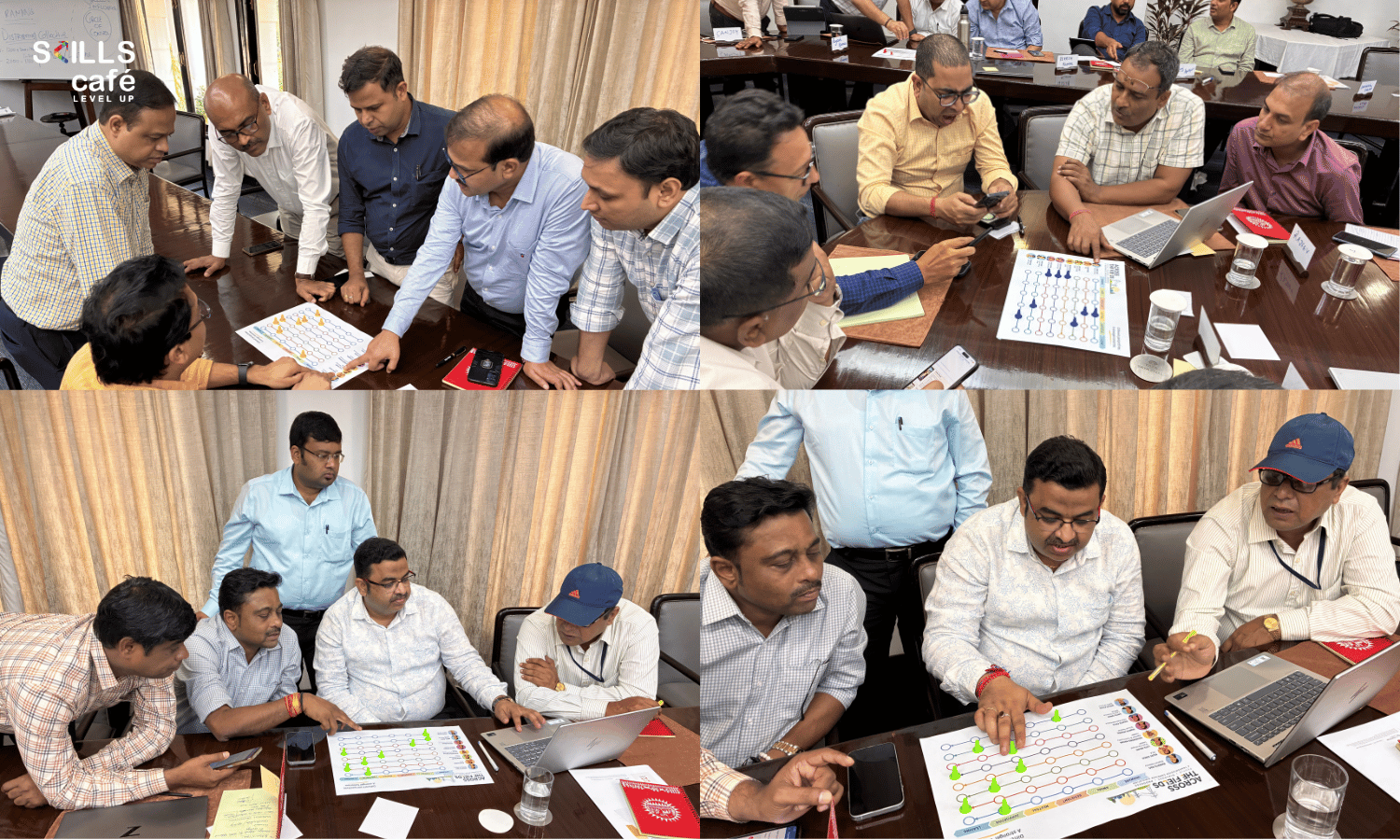
A larger simulation, Across the Field, placed participants in a power transmission project where a transmission corridor passed through a village and agricultural land. Teams had to engage multiple stakeholders with competing interests while applying the communication roles and techniques they had learnt.
Module 3: Communication During an Emergency
Communication changes when time is short and consequences are significant. Participants practised the CALM approach through scenarios such as reporting an incident, requesting urgent support, communicating an emergency and raising critical information during an ongoing meeting. The focus was on removing unnecessary background and communicating the critical information, required action and next steps with speed and clarity.
Module 4: Communicating with Leaders and Senior Stakeholders
The final module addressed communication with senior leaders, where interactions may be brief but disproportionately important. Participants practised structuring communication around four questions: What is the issue? What are the options? What do you recommend? What support is needed?
Exercises challenged participants to turn detailed operational information into concise presentations, recommendations and leadership conversations.
Practice, not just knowledge
Across the program, frameworks were quickly followed by cases, exercises, simulations, role plays and practice drills. Participants particularly valued the practical frameworks, workplace relevance and opportunities to work on communication challenges connected to their roles.
The learning design reflected a central Skills Café philosophy: professional skills are built by giving people a safe environment to make decisions, practise behaviours, experience consequences and try again.
Cases created context. Board games made invisible dynamics visible. Simulations introduced consequences. Practice drills helped turn knowledge into behaviour.