The context
India's renewable energy sector is scaling at a pace that places extraordinary demands on project execution. Wind and solar projects are larger, timelines are tighter, specialised manpower is scarce, contractors and resources are shared across locations, and delays in one part of the project can rapidly affect commissioning commitments elsewhere. Organisations cannot depend only on technically capable Site Incharges who execute instructions well. They need leaders who can anticipate risk, coordinate across functions, develop people, and take end-to-end accountability for delivery.
The Site Incharge role is often the first significant rung of people and project leadership. A Site Incharge may lead a multidisciplinary team of civil, electrical, mechanical, contractor and off-roll personnel while being responsible for a substantial project section. Strong performance can eventually lead to roles such as Project Head, Cluster Head or Project Manager.
The central development challenge is not simply improving current performance. It is preparing people to operate one level ahead.
The program design
The program was designed around three capability areas: Accountability and Ownership, Coaching and Mentoring, and Leading by Example.
From task orientation to end-to-end ownership
First: move participants from narrow task orientation to end-to-end ownership. Instead of "Did I complete what was assigned to me?" the question becomes "Is the final commitment protected?"
Participants learn to anticipate risks, challenge reassurance, surface red flags early, assign clear owners, follow through to closure and distinguish activity completion from outcome delivery. They also explore the boundary between ownership and over-involvement. A strong Site Incharge orchestrates the outcome by ensuring the right people act, dependencies are visible and issues are escalated while there are still choices.
Getting work done through others
Second: strengthen the ability to get work done through others — when to give clear direct instructions, when to provide information and technical expertise, and when to coach people to develop their own judgement.
Making leadership behaviour visible
Third: make leadership behaviour visible. On remote construction sites, people watch what the Site Incharge does, particularly under pressure. Safety, quality, reporting discipline, punctuality and respect are shaped less by slogans than by what the leader personally tolerates and demonstrates.
A simulation built backwards from failure
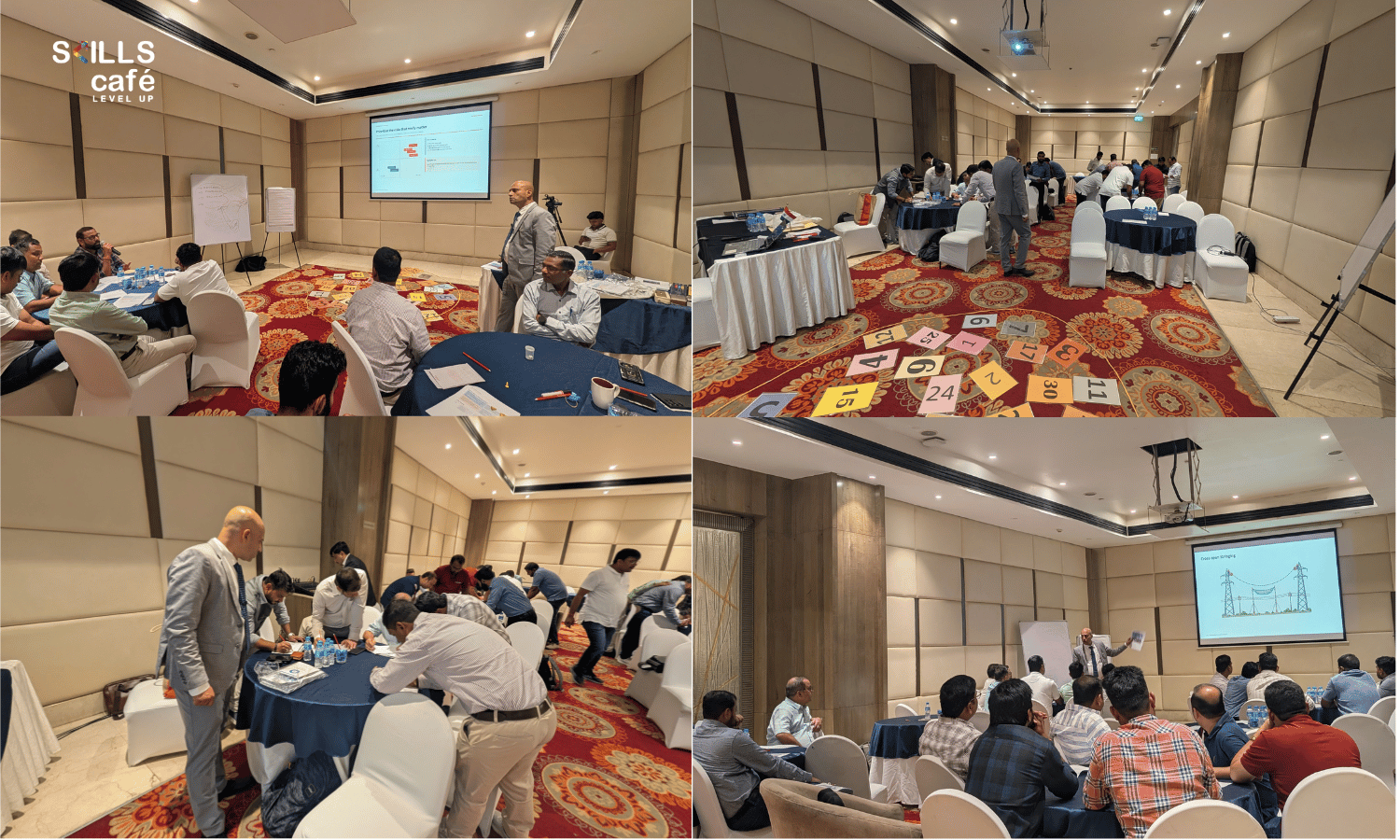
Participants are placed in Week 3 of a transmission-line project, responsible for a five-kilometre section. A critical Week 4 stringing activity must happen during a fixed utility shutdown window. The problem is immediately apparent: the project is unlikely to be ready. Foundation release is late. Materials are arriving with almost no buffer. A specialist stringing crew is shared with another project. Utility approval remains conditional.
Teams are then allowed to travel back in time to Weeks 1 and 2. They receive eight earlier events and only four intervention tokens. They must decide where intervention would have made the greatest difference.
Some signals appear minor at the time: hard rock at a nearby foundation, a delivery date technically before the required activity, a specialist crew "probably" available, a seemingly small documentation query from the utility.
The contrast between downstream management and upstream thinking becomes tangible. By Week 3, options are expensive and limited. In Week 1, there are often several ways to protect the outcome.
Taking the learning back to work
The workshop shifts into Wind and Solar project situations drawn from actual construction realities — delayed wind-turbine components, right-of-way constraints, shared equipment, inverter foundation readiness, module delivery delays and statutory approvals. Rather than merely identifying "what went wrong", participants create practical action plans around early-warning signals, ownership, escalation and closure.
Six months later: accountability at a different scale
The simulation changes the role. Six months after delivering the five-kilometre section, the participant leads the entire 100-kilometre project. Five Site Incharges own different sections — each with different risks, capability levels and behavioural patterns.
The new Project Lead cannot become the "sixth Site Incharge". Instead, participants design an operating system of accountability: what Site Incharges own, what comes to project level, which risks trigger escalation, what gets reviewed daily or weekly, and what should deliberately not be reviewed.
Leadership becomes visible under pressure
The final section focuses on Leading by Example using real-world Wind and Solar incidents and behaviour cards (Safety First, Honest Reporting, Procedural Discipline, Respect for People, Punctuality and Presence, Good Housekeeping, Check and Review).
In one scenario, a leader allows work beyond a quality hold point under month-end pressure. The real consequence is not the immediate shortcut — it is the permission signal sent to everyone watching. In another, a Site Leader personally stops a wind-turbine lift when wind speeds approach the limit, despite schedule pressure. The behaviour establishes a standard that others follow without waiting for instruction.
Leadership at site is not only about getting today's work done. It is about creating the conditions, judgement, discipline and capability that allow the whole project to succeed, even when the leader is not personally controlling every activity.