The Context
Collections leadership is a demanding operating environment. Leaders must deliver numbers in the present while managing portfolio risk, compliance, people capability, cost, customer realities, and an increasingly uncertain business environment.
The leaders identified for this intervention were experienced managers across the collections organization. Most were strong operators who understood their markets and knew how to intervene when performance slipped. The development challenge was not to teach them how to manage collections better. It was to help them make the transition from experienced operators to leaders who could build people, create systems, anticipate risks, and prepare the business for what came next.
The central learning objective was therefore:
Develop leadership capability and future orientation in mid- to senior-level leaders within the Collections function.
The journey focused on three interconnected leadership worlds:
- Developing Self: self-awareness, ownership, change agility and personal leadership.
- Developing People: delegation, coaching, feedback, goal clarity, accountability and development of the second line.
- Developing the Business: long-term planning, strategy execution, root-cause analysis, business decision-making and future readiness.
Rather than beginning with a standard leadership curriculum, the program was built around evidence gathered from the organization itself.
1.Starting with Diagnosis, Not Content
The first stage was a detailed learning-needs diagnostic.
A series of facilitated focus group discussions was conducted with leaders across Urban, Rural and SME Collections. The discussions included both the target population and leaders at adjacent levels, allowing the design team to understand the leadership experience from more than one perspective.
Eleven focus group discussions were used to explore questions such as:
- Where do leaders spend most of their time today?
- What decisions continue to get escalated upwards?
- Where does leadership break down across layers?
- How effectively are managers developing their teams?
- Are leaders working primarily from historical MIS, or are they anticipating what may happen next?
- How strong is the second line of leadership?
- How do managers behave when numbers, people issues and compliance pressures collide?
The findings were consolidated into a diagnostic needs report that became the basis of the learning architecture.
One important pattern emerged: many leaders were effective at solving immediate problems themselves. The next stage of leadership required something different, moving upstream, diagnosing systems, building the capability of others and balancing immediate execution with longer-term business health.
2. Multi-Rater Pre-Assessment
The diagnostic was followed by a structured pre-assessment.
Instead of relying on a conventional knowledge test, leadership capability was examined through multiple lenses:
- Simulation-based assessment: Leaders responded to realistic managerial and business situations requiring judgement and prioritization.
- Self-assessment: Participants reflected on their own leadership behaviours.
- Manager assessment: Reporting managers rated the same underlying leadership dimensions from their perspective.
- Team/reportee perspective: Where applicable, team feedback provided an additional view of observable leadership behaviour.
Using common constructs with perspective-specific wording enabled the assessment to identify both strengths and potential blind spots.
This created a richer baseline than a single rating could provide. A leader might, for example, see themselves as highly developmental while their team experienced frequent intervention and limited delegation. Such differences became useful inputs for reflection and coaching rather than merely scores.
3. A Two-Day Intensive Leadership Lab
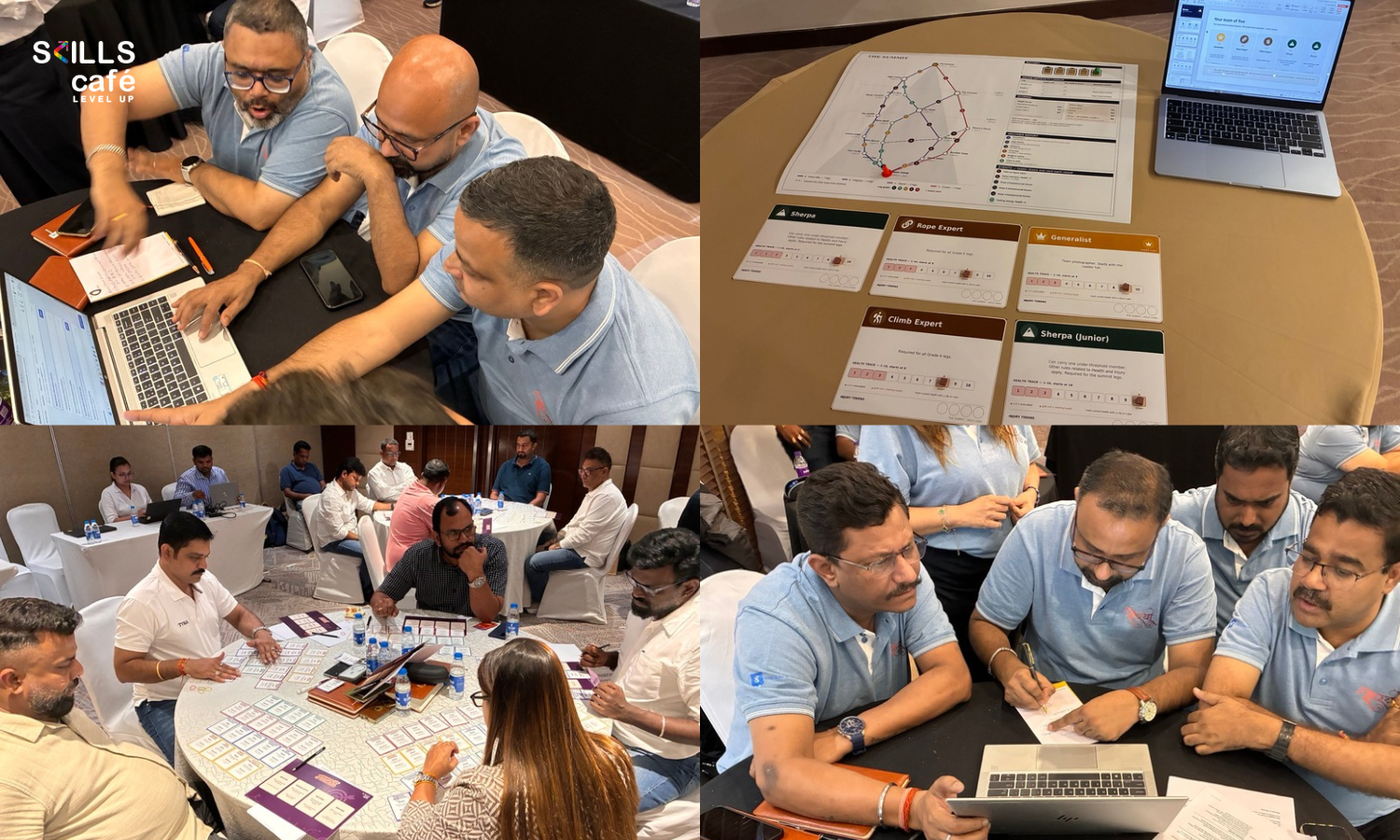
The core workshop was designed as an intensive two-day experiential leadership lab.
The design deliberately avoided a theory-heavy classroom format. Approximately half the workshop was devoted to practice, with the remaining time divided between practical tools, examples, reflection and short conceptual inputs.
Day 1: Leading Self and Leading People
The first day began with the leader rather than the business.
Participants examined their current leadership patterns through reflection exercises and experiential activities. A Speed Boat exercise helped leaders surface forces helping or slowing their leadership journey and establish the transition they wanted to make.
The program then moved into people leadership.
Participants worked with situations involving:
- delegation versus personal intervention;
- clarifying expectations and goals;
- diagnosing skill and will;
- conducting effective check-ins;
- developmental feedback;
- coaching using structured conversations;
- stretch assignments;
- motivation and engagement;
- career conversations;
- building the next line of leaders.
Cases, role plays, coaching drills and decision exercises forced participants to choose an approach and experience its consequences.
The objective was not simply to introduce tools. Leaders had to practise when to direct, when to provide information, when to coach, and when to step back.
Day 2: Leading the Business
The second day progressively shifted the perspective from team leadership to business leadership.
The centrepiece was a customised business simulation, Run the Zone, in which participants operated a fictitious collections business.
Rather than receiving a neat case with one correct solution, participants worked through evolving rounds of business information and made decisions under competing pressures.
They had to balance areas such as:
- collection performance;
- portfolio and emerging risk;
- manpower and capacity;
- agency performance;
- people capability;
- compliance;
- cost;
- near-term delivery;
- future readiness.
The simulation was deliberately constructed around a fundamental leadership tension:
Do I optimise today's number, or invest in actions that strengthen tomorrow's performance?
Decisions produced consequences in later rounds. Apparently business problems have retained their irritating habit of not respecting PowerPoint slide boundaries.
Teams therefore had to analyse causes rather than symptoms, interpret leading indicators, allocate limited resources, challenge assumptions and explain the rationale behind their decisions.
The simulation brought together five critical capabilities:
long-term planning, strategy execution, root-cause analysis, business decision-making and future readiness.
Games, simulations and role-based challenges were used throughout the workshop because leadership capability is difficult to develop through explanation alone. Participants had to make decisions, defend them, observe consequences and reconsider their thinking.
4. Action Projects: Taking Learning Back to Work
The workshop was designed as the beginning of application, not the end of the intervention.
Each participant selected action projects linked to real business or leadership priorities. These could include areas such as:
- developing a new collections strategy;
- improving digital adoption;
- strengthening compliance;
- building risk early-warning mechanisms;
- delivering results with a leaner team;
- improving succession and second-line capability;
- leading cross-functional initiatives;
- planning for future uncertainty.
The projects converted leadership development from intention into observable workplace behaviour.
5. Coaching Circles and Peer Accountability
Participants reconvened through Coaching Circles, including structured checkpoints around Day 45 and Day 90.
The circles were designed around application rather than additional teaching.
Participants discussed:
- What have I tried?
- What changed?
- Where am I stuck?
- What resistance am I encountering?
- What am I learning about my own leadership?
- What will I do differently next?
Peers challenged one another, shared approaches and created accountability. Managers were also expected to support the application process, ensuring that development did not sit separately from the participant's actual role.
6. Action Project Presentations
Participants ultimately presented their action projects, explaining the original challenge, actions taken, decisions made, obstacles encountered, evidence of progress and lessons learnt.
This was an important design choice.
A presentation requires participants to make their learning visible. It shifts the question from "Did you attend the program?" to "What did you actually change?"
7. Post-Assessment and Reporting
The journey concluded with a post-assessment, supported by action-project evidence.
Results from the initial diagnostic, multi-rater assessment, simulations, post-assessment and application projects could then be brought together at two levels.
Individual Leadership Report
Each participant received a developmental picture covering:
- demonstrated strengths;
- priority development areas;
- differences between self and stakeholder perceptions;
- progress across the journey;
- evidence from simulations and action projects;
- recommended areas for continued development.
Cohort Report
A consolidated report provided leadership and L&D teams with an organizational view of:
- common strengths;
- recurring capability gaps;
- movement between pre- and post-assessment;
- action-project themes;
- patterns across different participant groups;
- priorities for future leadership development.
This transformed assessment data from an HR exercise into an input for broader talent and capability decisions.
Leadership Development as a Journey
The strongest feature of the approach was not any single workshop, simulation or leadership model. It was the architecture connecting them:
Diagnose → Assess → Experience → Practise → Apply → Coach → Demonstrate → Reassess.
This reflects established good practice in leadership development.
The learning was grounded in the organization's actual context. Assessment used multiple perspectives. Participants practised leadership through realistic decisions rather than merely discussing concepts. Application projects connected development to business outcomes. Coaching and peer accountability supported transfer. Post-assessment looked for evidence of change. Individual and cohort reporting enabled both personal development and organizational learning.
Most importantly, the journey treated leadership development not as an event, but as a process of changing how experienced managers think, decide, develop others and prepare their business for the future.